Book Overview
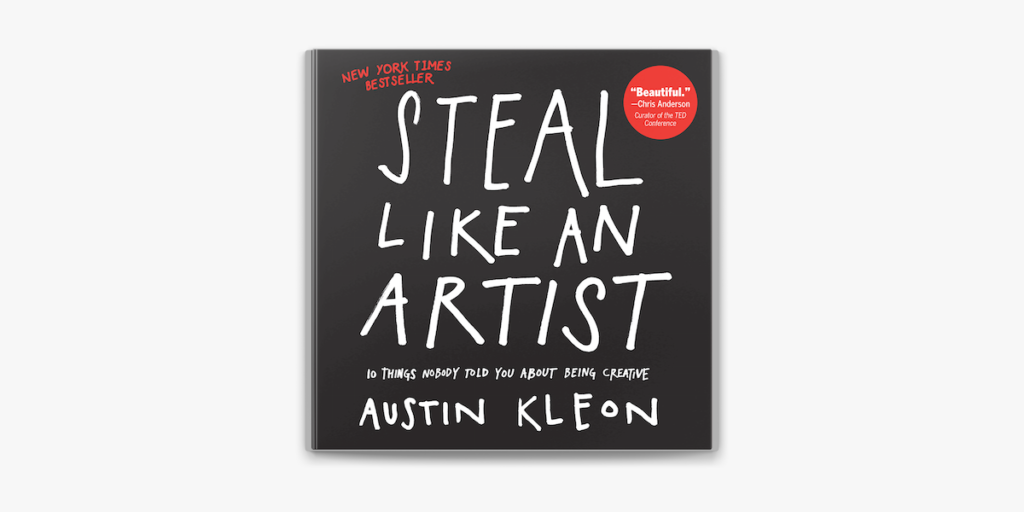
Title: Steal Like an Artist
Author: Austin Kleon
Category: Creativity / Personal Development / Art & Design
Why I Picked This Book:
I’ve been paralyzed by the belief that I need an “original” idea before I can create anything. Every time I start something, a voice says “this has been done before” and I stop. This book’s title alone challenged that premise, maybe originality is a myth, and maybe stealing (the right way) is how great work actually happens. I needed permission to borrow, remix, and build on what already exists instead of waiting for lightning to strike.
Who Should Read This
This book is for anyone who also paralyzed by the myth of originality; writers, designers, musicians, entrepreneurs, anyone who creates or wants to. It’s for people stuck in analysis paralysis waiting for the “perfect” idea. It’s for creatives who feel guilty about being influenced by others and think “stealing” is cheating. It’s for side-project junkies who feel scattered and need permission to see their many interests as assets, not distractions. It’s for people who think they need to quit their day job to be a “real” artist. And it’s for anyone drowning in tools, options, and information who needs to hear: constraints are liberating, subtraction is creative, and boring routines enable brilliant work. If you want to make things but don’t know where to start, start here.
Core Ideas & Highlights
1. Nothing is Original, Every Idea is a Remix
Every new idea is just a mashup or remix of one or more previous ideas. We are shaped and fashioned by what we love. The genealogy of ideas means everything you create is standing on the shoulders of what came before. You’re only going to be as good as the stuff you surround yourself with. Garbage in, garbage out. First, figure out what’s worth stealing, then move on to the next thing.
2. Climb Your Own Family Tree
Chew on one thinker you really love. Study everything about that thinker. Then find three people that thinker loved, and find out everything about them. Repeat this as many times as you can. Climb up the tree as far as you can go. Once you build your tree, it’s time to start your own branch. Always your job to get yourself an education. Go deeper than anybody else, that’s how you’ll get ahead. Google everything. Always be reading. Read bibliographies. Collect books.
3. Save Your Thefts for Later, Keep a Swipe File
Carry a notebook and pen wherever you go. Get used to pulling it out and jotting down thoughts and observations. Copy your favorite passages out of books. Record overheard conversations. Doodle when you’re on the phone. Keep a swipe file: a file to keep track of the stuff you’ve swiped from others. It can be digital or analog. This becomes your raw material for future work.
4. Don’t Wait Until You Know Who You Are to Get Started
Make things, know thyself. You’re ready to start making stuff now. Fake it till you make it. You have to dress for the job you want, not the job you have, and you have to start doing the work you want to be doing. Start copying what you love. Copy copy copy copy. At the end of the copy you will find yourself. If you copy from one author, it’s plagiarism, but if you copy from many, it’s research. Don’t just steal the style, steal the thinking behind the style.
5. Imitation is Not Flattery, Move to Emulation
At some point, you’ll have to move from imitating your heroes to emulating them. Imitation is about copying. Emulation is when imitation goes one step further, breaking through into your own thing. Copy your heroes. Examine where you fall short. What’s in there that makes you different? That’s what you should amplify and transform into your own work.
6. Write the Book You Want to Read
The best advice is not to write what you know, it’s to write what you like. Write the kind of story you like best, write the story you want to read. Whenever you’re at a loss for what move to make next, just ask yourself, “What would make a better story?” Draw the art you want to see, start the business you want to run, play the music you want to hear, write the books you want to read, build the products you want to use, and do the work you want to see done.
7. Use Your Hands, Step Away from the Screen
Work that only comes from the head isn’t any good. You need to find a way to bring your body into your work. If we just start going through the motions, the motion kickstarts our brain into thinking. If you have the space, set up two workstations; one analog and one digital. Stand up while you’re working. Pin things on the walls and look for patterns. The physical act of making activates different parts of your brain than purely digital work.
8. Side Projects and Hobbies Are Important, Practice Productive Procrastination
The work you do while you procrastinate is probably the work you should be doing for the rest of your life. It’s the side projects that really take off, the stuff you thought was just messing around. Stuff that’s just play. I think it’s good to have a lot of projects going at once so you can bounce between them. Take time to be bored. Creative people need time to just sit around and do nothing. Take time to mess around. Get lost, wander. You never know where it’s going to lead you.
9. Don’t Throw Any of Yourself Away
You can’t connect the dots looking forward, you can only connect them looking backwards. Keep all your passions in your life. If you love different things, just keep spending time with them. It’s so important to have hobbies. A hobby is something creative that’s just for you. The weird interests and obsessions you have now might become the foundation of your best work later.
10. The Secret: Do Good Work and Share It With People
In the beginning, obscurity is good. There’s no pressure when you’re unknown. You can do what you want, experiment, do things just for the fun of it. When you’re unknown, there’s nothing to distract you from getting better. Do good work and share it with people. Wonder at things nobody else is wondering about. When you open up your process and invite people in, you learn. You don’t put yourself online only because you have something to say, you can put yourself online to find something to say.
11. Geography is No Longer Our Master, Build Your Own World
All you need is a little space and a little time: a place to work, and some time to do it; a little self-imposed solitude and temporary captivity. Sometimes you can find solitude and captivity in the wild. Leave home: Your brain gets too comfortable in your everyday surroundings. You need to make it uncomfortable. Spend time in another land, among people who do things differently than you. Travel makes the world look new, and when the world looks new, our brain works harder. You have to find a place that feeds you; creatively, socially, spiritually, and literally.
12. Be Nice, The World is a Small Town
Make friends, ignore enemies. The best way to vanquish your enemies on the internet? Ignore them. The best way to make friends on the internet? Say nice things about them. Stand next to the talent: You’re only going to be as good as the people you surround yourself with. Find the most talented person in the room, and if it’s not you, go stand next to them. Hang out with them. Try to be helpful. If you ever find that you’re the most talented person in the room, you need to find another room.
13. Write Fan Letters, Show Appreciation Without Expecting Anything
Write a blog post about someone’s work that you admire and link to their site. Make something and dedicate it to your hero. Answer a question they’ve asked, solve a problem for them, or improve on their work and share it online. The important thing is that you show your appreciation without expecting anything in return, and that you get new work out of the appreciation. Validation is for parking. You can’t go looking for validation from external sources. Once you put your work into the world, you have no control over the way people will react to it. The trick is to be too busy doing your work to care.
14. Keep a Praise File
Save good comments or feedback from digital or analog platforms in a file called a praise file. Use it sparingly but keep it around for when you need a lift. This becomes your reminder on hard days that your work matters to someone.
15. Be Boring, It’s the Only Way to Get Work Done
Take care of yourself. It takes a lot of energy to be creative. You don’t have that energy if you waste it on other stuff. Stay out of debt. Learn about money as soon as you can. It’s not the money you make, it’s the money you hold on to. Make yourself a budget. Live within your means. The art of holding on to money is all about saying no to consumer culture.
Keep your day job (If you have one). A day job gives you money, a connection to the world, and a routine. Freedom from financial stress also means freedom in your art. A day job puts you in the path of other human beings. Learn from them, steal from them. The worst thing a day job does is take time away from you, but establishing and keeping a routine can be even more important than having a lot of time. Figure out what time you can carve out, what time you can steal, and stick to your routine. Do the work every day, no matter what. No holidays, no sick days. Don’t stop. Work gets done in the time available (Parkinson’s Law).
16. Creativity is Subtraction, Choose What to Leave Out
Concentrate on what’s really important to you. Start a business without any startup capital. Don’t make excuses for not working, make things with the time, space, and materials you have right now. The right constraints can lead to your very best work. Embrace your limitations and keep moving. Creativity is not just the things we choose to put in, it’s the things we choose to leave out. Choose wisely and have fun.
My Reflections & Thinking
What resonated with me
- “Nothing is original, every idea is a remix.” This obliterates the perfectionist’s paralysis I’ve been stuck in. I’ve been waiting for a completely original idea that will never come. But if everything is built on what came before, my job isn’t to invent from nothing, it’s to steal intelligently and remix uniquely. That’s actionable.
- “The work you do while you procrastinate is probably the work you should be doing for the rest of your life.” This reframes my “distraction” projects as signals, not noise. The things I can’t stop thinking about, the side projects I sneak time for, those aren’t procrastination, they’re compasses pointing toward my real work.
- “If you’re the most talented person in the room, find another room.” I’ve been comfortable being the best in small circles. But Kleon’s message is clear: comfort is death. Growth requires discomfort. I need to seek out rooms where I’m the least talented person, where I’m forced to level up.
What challenged or changed my perspective
- “Fake it till you make it” and “start copying what you love.” I’ve always believed authenticity means being original from day one. But Kleon says: imitate first, find yourself later. Copy your heroes until you discover what makes you different. That feels like permission to suck, to be derivative, to learn by doing instead of waiting for some mystical “voice” to emerge.
- “Keep your day job.” This contradicts the “quit your job and chase your dreams” narrative I’ve internalized. But Kleon argues: a day job gives you money, routine, human connection, and freedom in your art because you’re not desperate. It’s not a cage, it’s a foundation. That reframes my 9-5 from failure to strategy if implemented right.
- “Creativity is subtraction, choose what to leave out.” I’ve been obsessed with adding more: more skills, more projects, more tools. But Kleon says the magic is in constraints, in choosing what NOT to do. That’s harder than adding. It requires clarity about what actually matters and the discipline to say no to everything else.
Final Note
This book didn’t teach me “how to be original.” It taught me that originality is a myth and a trap. The real work is stealing intelligently; finding heroes, studying them deeply, copying their thinking (not just their style), then emulating until you break through into your own thing. Kleon’s framework; climb your family tree, keep a swipe file, write the book you want to read, use your hands, do good work and share it, be boring, embrace constraints, removes the mysticism from creativity. It’s not about waiting for inspiration. It’s about showing up daily, stealing from the best, experimenting with combinations, and trusting that your unique remix will emerge from the process. I’ve been waiting for permission to create without being “original.” This book gave it to me. Nothing is original. Everything is a remix. My job isn’t to invent from scratch, it’s to be a great thief. Steal the thinking behind the work I admire, combine influences in ways only I can, and make something that didn’t exist before. That’s not plagiarism. That’s art. So I’m done waiting for the perfect, original idea. I’m going to start copying, start making, start sharing. Because at the end of the copy, I’ll find myself. And that’s the only originality that matters.