
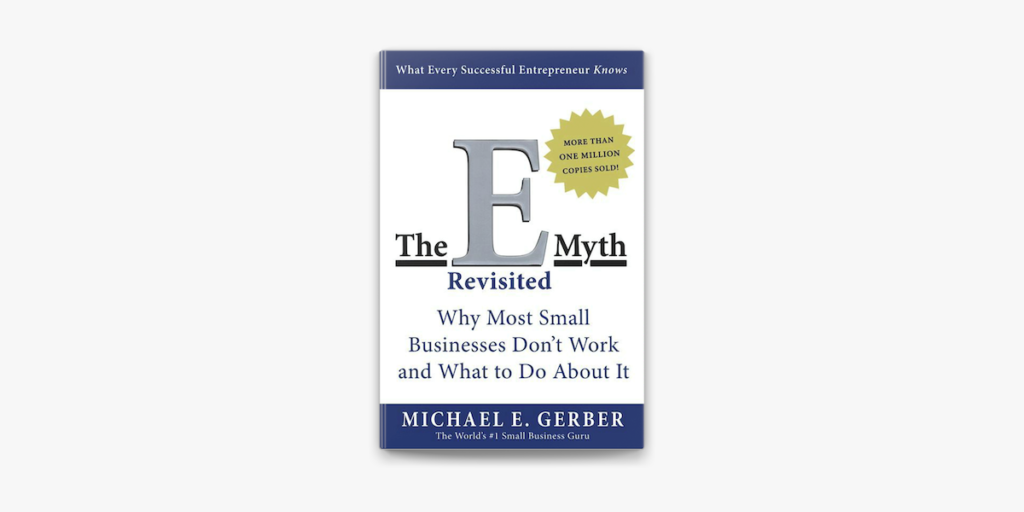
Book Overview
Title: E-Myth Revisited
Author: Michael E. Gerber
Category: Business & Entrepreneurship / Small Business / Systems & Operations
Why I Picked This Book:
I started a business thinking passion and technical skill were enough. I’ve heard this book mentioned repeatedly by successful entrepreneurs who say it transformed how they think about building a business. I needed to understand why my business owns me instead of the other way around and how to fix it.
Who Should Read This
This book is for small business owners who feel trapped by their businesses working in them instead of on them. It’s for technical experts (bakers, designers, consultants, developers) who started a business because they’re good at the work, but now realize doing the work and running a business that does the work are completely different things. It’s for entrepreneurs stuck in the daily grind with no systems, no time, and no freedom. It’s for anyone who’s had an “entrepreneurial seizure” and thought “I can do this better myself” only to discover they’ve created a job, not a business. If you want to build a business that works without you, not because of you, this is your manual.
Core Ideas & Highlights
1. The Fatal Assumption: Technical Work ≠ Running a Business
The Fatal Assumption is: if you understand the technical work of a business, you understand a business that does that technical work. But the technical work of a business and a business that does that technical work are two totally different things! Most small businesses are started by technicians suffering from an “entrepreneurial seizure”, the moment you think “I can do this better myself” and decide to start your own business. The symptom: excitement, obsession with independence, irresistible urge to be your own boss. But this leads to disaster because technical skill doesn’t equal business skill.
2. The Three Personalities: Entrepreneur, Manager, Technician
Everybody who goes into business is actually three-people-in-one: The Entrepreneur, The Manager, and The Technician. The problem: while each wants to be the boss, none wants to have a boss.
The Entrepreneur is the visionary, the dreamer. Lives in the future, never in the past, rarely in the present. Craves control, thrives on change, sees opportunities everywhere. Creates chaos and possibility.
The Manager is pragmatic. Lives in the past. Craves order, clings to the status quo, sees problems instead of opportunities. Creates neat, orderly rows. Runs after The Entrepreneur to clean up the mess.
The Technician is the doer. Lives in the present. Loves the feel of things getting done but only one thing at a time. Works steadily, happiest when in control of the work flow.
The typical small business owner is only 10% Entrepreneur, 20% Manager, and 70% Technician. This imbalance dooms the business before it begins.
3. If Your Business Depends on You, You Don’t Own a Business You Have a Job
“If your business depends on you, you don’t own a business you have a job. And it’s the worst job in the world because you’re working for a lunatic!” When customers come to you because of your ability to give them what they want, not the business’s ability, you’ve created dependency, not a business. The purpose of going into business is to get free of a job so you can create jobs for other people. The purpose is to expand beyond your existing horizons, to invent something that satisfies a need in the marketplace that has never been satisfied before.
4. The Entrepreneurial Perspective: How Must the Business Work?
The Entrepreneurial Perspective asks: “How must the business work?” It sees the business as a system for producing outside results for the customer resulting in profits. It starts with a picture of a well-defined future, then comes back to the present with the intention of changing it to match the vision. It envisions the business in its entirety, from which is derived its parts. It’s an integrated vision of the world where the present is modeled after the vision. The business operates according to articulated rules and principles. It has a clear, recognizable form.
5. The Franchise Prototype: Your Business as a Product
The secret is the Franchise Prototype. Think of your business not as a place where you do work, but as a product, something that can be replicated, systematized, and sold. The franchisor has designed the business so well that every problem has been thought through. All that’s left for the franchisee is to learn how to manage the system. The system isn’t something you bring to the business. It’s something you derive from the process of building the business. The true product of a business is the business itself.
6. Work ON Your Business, Not IN It
Your business is not your life. The primary purpose of your business is to serve your life. You can then go to work on your business, not in it. The rules of the game:
(1) The model will provide consistent value to customers, employees, suppliers, and lenders, beyond what they expect.
(2) The model will be operated by people with the lowest possible level of skill meaning the lowest level necessary to fulfill the functions for which each is intended. Great businesses are not built by extraordinary people but by ordinary people doing extraordinary things. The system becomes the tool.
(3) The model will stand out as a place of impeccable order; structure provides the fixed points of reference we need.
(4) All work will be documented in Operations Manuals; documentation provides structure and a written account of how to get the job done.
(5) The model will provide uniformly predictable service—consistency to the experience. What you do is not as important as doing it the same way, each and every time.
(6) The model will utilize a uniform color, dress, and facilities code; the business is a package for your product.
7. The Business Development Process: Innovation, Quantification, Orchestration
Innovation: Change the way you approach things. Innovation is the signature of a bold, imaginative hand. Where the business is the product, how the business interacts with the consumer is more important than what it sells.
Quantification: Numbers enable you to determine the precise value of your innovation. How would you know a greeting change produced a 16% increase in sales unless you quantified it? Count people, purchases, dollar values before and after changes. Data is everything.
Orchestration: The elimination of discretion, or choice, at the operating level of your business. If you haven’t orchestrated it, you don’t own it! Orchestration is your unique way of doing business. The Business Development Process is dynamic, the world won’t tolerate a stationary object.
8. Your Primary Aim: What Do You Wish Your Life to Look Like?
Before you start your business, ask yourself: What do I wish my life to look like? How do I wish my life to be on a day-to-day basis? How would I like to be with other people? How would I like people to think about me? What would I like to be doing two years, ten years, twenty years from now? What do I need to learn? How much money will I need? By when? Great people create their lives actively, while everyone else is created by their lives, passively waiting to see where life takes them next. Your business must serve your Primary Aim, not the other way around.
9. Your Strategic Objective: Clear Standards for Success
Your Strategic Objective is a very clear statement of what your business has to ultimately do for you to achieve your Primary Aim.
The First Standard: Money. How much money do you need in assets (not income) to live the way you wish? To be independent of work, to be free? There is ultimately only one reason to create a business of your own: to sell it!
The Second Standard: An Opportunity Worth Pursuing. Does the business you have in mind alleviate a frustration experienced by a large enough group of consumers to make it worth your while? What kind of business am I in? The commodity is the thing your customer walks out with. The product is what your customer feels as they walk out. People buy feelings.
10. Your Organizational Strategy: Organize Around Functions, Not Personalities
Most companies organize around personalities rather than around functions, around people rather than accountabilities. The result is chaos. Without an Organization Chart, everything hinges on luck and good feelings. You need to create an Organization Chart with clear positions and accountabilities: President/COO, VP Marketing, VP Operations, VP Finance, and reporting positions under each. A Position Contract is a summary of the results to be achieved by each position, the work they’re accountable for, standards for evaluation, and a signature line. Accountability literally means “stand up and be counted.”
11. Your Management Strategy: A System, Not a Person
A Management System is a System designed into your Prototype to produce a marketing result. The more automatic that System is, the more effective your Franchise Prototype will be. Management Development is not a management tool, it is a marketing tool. Its purpose is not just to create an efficient Prototype but an effective one. The system knows what the customer likes and makes certain they get it, in exactly the same way, at exactly the same time. The System produces the results; your people manage the system.
12. Your People Strategy: Create a Game Worth Playing
“If you want it done, you’re going to have to create an environment in which ‘doing it’ is more important to your people than not doing it.” The work we do is a reflection of who we are. If we’re sloppy at it, it’s because we’re sloppy inside. Work is passive without you, it’s only an idea before a person does it. Make sure your people understand the idea behind the work they’re being asked to do. People want to work for people who have created a clearly defined structure for acting in the world. A structure through which they can test themselves. Such a structure is called a game. Most people today are not getting what they want. What’s missing is a Game Worth Playing, a place of community that has purpose, order, and meaning.
13. Your Marketing Strategy: Forget About You, Focus on Your Customer
When it comes to marketing, what you want is unimportant. It’s what your customer wants that matters. What your customer wants is probably significantly different from what you think they want. Demographics is the science of marketplace reality, it tells you who buys. Psychographics is the science of perceived marketplace reality, it tells you why they buy. The marketing question: What must our business be in the mind of our customers in order for them to choose us over everyone else? The customer you’ve got is a hell of a lot less expensive to sell to than the customer you don’t have yet.
14. Your Systems Strategy: Hard, Soft, and Information Systems
Three kinds of systems: (1) Hard Systems are inanimate, unliving things (computers, colors). (2) Soft Systems are either animate or ideas (people, scripts). (3) Information Systems provide information about the interaction between the other two (inventory control, cash flow forecasting).
A selling system is a fully orchestrated interaction that follows six steps: identify Benchmarks (consumer decision points), script the words, create materials, memorize scripts, deliver identically, leave people free to communicate effectively. The Power Point Selling System is composed of Structure (what you do—what you say, materials you use, what you wear) and Substance (how you do it—how you say it, how you use it, how you are).
15. Your Business is a Dojo: A Practice Hall for Life
A small business is a miniature cosmos where we make contact with ourselves; our fears, anxieties, reactions, and habits. It’s an arena of confined conflict where we confront challenges that help us understand ourselves more fully. A small business is a place that responds instantly to any action we take. A place where we can practice implementing ideas in a way that changes lives. It’s a true practice hall. A world of our own. The very process of Business Development creates instantaneous change in the people who engage in it.
My Reflections & Thinking
What resonated with me
- “If your business depends on you, you don’t own a business—you have a job.” This destroys the illusion I’ve been operating under. I thought I was building a business, but I’ve just created the worst job imaginable. If I take a week off, everything collapses. That’s not freedom. That’s a trap. I need to build systems that work without me.
- The 10% Entrepreneur, 20% Manager, 70% Technician split. This explains why I’m drowning. I spend 70% of my time doing technical work because I love it and I’m good at it. But the business needs me to spend time being The Entrepreneur (vision, strategy) and The Manager (order, systems). I’ve been avoiding the work that actually builds a business.
- The Franchise Prototype mindset. Even if I never want to franchise, thinking of my business as something that could be replicated forces me to systematize everything. If I can’t explain how to do it in a manual, I don’t really understand it. That’s the filter I’ve been missing.
What challenged or changed my perspective
- “Great businesses are not built by extraordinary people but by ordinary people doing extraordinary things.” This contradicts everything I’ve believed about hiring. I’ve been waiting to find “rockstars” who can match my skill level. But Gerber says: build a system so good that ordinary people can produce extraordinary results. The system is the asset, not the people. That’s uncomfortable but liberating.
- The only reason to create a business is to sell it. I’ve never thought about an exit. I’ve been building a job, not an asset. But if I can’t sell it, if the business has no value without me then what am I actually building? This reframes everything: every decision should increase the business’s value as a sellable asset.
- People buy feelings, not commodities. I’ve been obsessed with product features and technical quality. But Gerber says: people buy how they feel when they walk out, not what they walk out with. That shifts the entire focus from the thing itself to the experience around the thing. I’ve been solving the wrong problem.
Final Note
This book didn’t teach me “how to grow faster” or “how to scale revenue.” It taught me I’ve been building the wrong thing entirely. I thought I was building a business. I was actually building a complicated job that requires 80 hours a week to keep alive. Gerber’s framework; the three personalities (Entrepreneur, Manager, Technician), the Franchise Prototype, working ON the business not IN it, the seven development programs (Primary Aim, Strategic Objective, Organizational Strategy, Management Strategy, People Strategy, Marketing Strategy, Systems Strategy) gives me a roadmap to transform a job into an asset. The key insight: the business is the product, not the thing the business sells. If I can’t replicate it, systematize it, document it, and hand it to someone else to run, I don’t own a business. I own a job. And the only way to build a real business is to think like a franchisor from day one: create a system so clear, so documented, so orchestrated that ordinary people can produce extraordinary results without me. I’ve been working IN my business for years. I’m exhausted. I’m trapped. I’m the bottleneck. So I’m going to start working ON it instead. I’m going to write my Primary Aim, what I want my life to look like. I’m going to define my Strategic Objective, what the business must do to serve that life. I’m going to build an Organization Chart with Position Contracts for every role, even if I’m filling all the roles right now. I’m going to document every process in an Operations Manual. I’m going to create systems, not just habits. Because the only business worth building is one that works without you. And I’m done being a slave to the thing I created.