
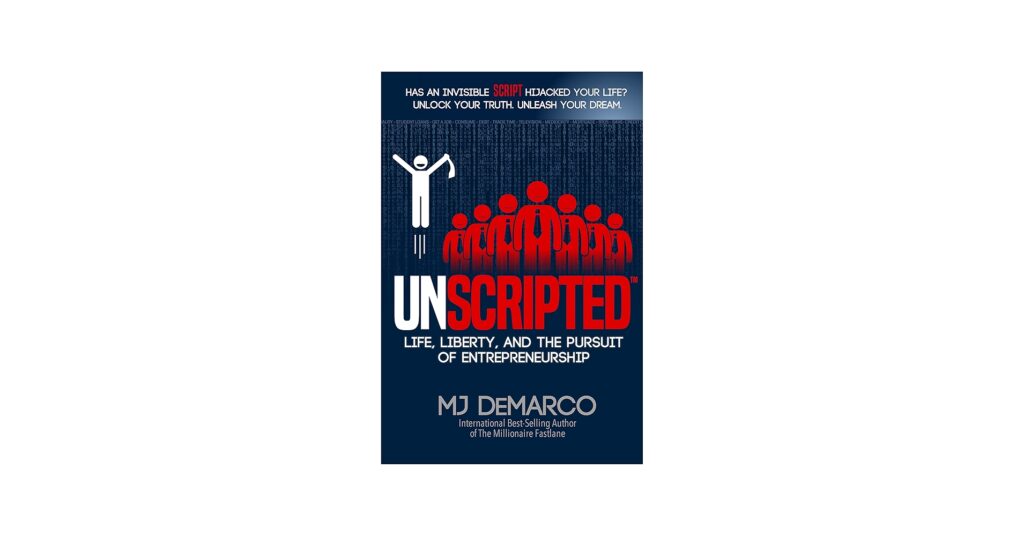
This book is for people who feel trapped by the default path or something is wrong with your current path but don’t know how to escape without being reckless. It’s for competent professionals realizing their degree and hard work aren’t producing the freedom they were promised. It’s for parents who want to build wealth without sacrificing their kids’ childhoods. It’s for strategic thinkers who see the “Script” clearly; work, consume, repeat and are ready to design something different. It’s for builders willing to work hard but tired of working hard in a system that always against them. If you’ve ever felt “same shit, different day” and wondered if there’s more, this book is your wake-up call.
Why I Picked This Book
I’m a father of two watching my kids grow up while I trade hours for money in a system that promised security but delivers anxiety. The “Script”: get a degree or until master or PHD, get a job, work 40 years, retire, feels more like a trap, not a strategy. DeMarco’s promise: there’s a way out that doesn’t require waiting until you’re 65. I needed to know if he’s selling another get-rich-quick scam or if there’s actual substance behind the provocative title.
Core Ideas & Highlights
1. The Script—You’re Living Someone Else’s Life
We’re living in the scripted life. Manufactured by conventional wisdom, distributed by institutionalized indoctrination, swallowed by blind faith, and the product being manufactured is YOU. Conventional = ordinary + mediocrity. The book define the Script as is conventional wisdom directing a conventional life, dispensed by either a compromised party of convention (the crowd) or a profiteering party of prejudice (the money). The Script produces M.O.D.E.L. citizenship: Mediocre, Obedient, Dependent, Entertained, Lifeless. The Seeders are: friends and family, education, corporate, financial, government, media. They plant the Script in your head before you even know what’s happening.
2. Nine Scripted Hyperrealities—Your Illusionary Captors
Named Days: The illusion that your life’s limited time must be systematically segregated by days, with each day’s title designing whether work or play is expected. Consumerism: The myth that consumption can produce success or happiness. College Degree: The stale idea that intelligence and wealth require a college degree regardless of cost, and that your degree entitles you to a job. Hyper-Personality: A public image that does not represent the real, humanized version of the individual. Virtual Reality: Captivating simulation exploiting competition, goal achievement, faux improvement, positive feedback loops. Entertainment: An irrational investment where the investment becomes part of your identity or an erroneous belief about reality. Money: The belief that physical or virtual money is valuable and that the person possessing it is equally valuable. Freedom: The perception that we’re born free and unencumbered. Corporations: The perception that corporations are evil, faceless superstructures.
3. Temporal Prostitution—Trading Good Time for Bad
The subordination of time for money: the presumption that time is unlimited and can be fecklessly traded, while money is piously coveted as a limited resource. Under temporal prostitution, the things you buy cost more than just money—they cost future fragments of your life, transforming free time into indentured time. Indentured time is time someone else owns: school, studying, work, traffic, your business. Our real goal is to have more free time versus indentured time. Be intentional with your life. The two doors at the end of the Script: (1) The Sidewalk (trade tomorrow for today—live to consume) and (2) The Slowlane (trade today for tomorrow—deprivation mentality, hope, save-work-invest-wait-repeat). Many who struggle financially have strong work ethics. The problem is their “hard work” is being channeled in an ineffective and outdated system.
4. The “Fuck This” Event—Your Catalyst for Change
Before you can escape the matrix, you have to experience what DeMarco calls a “Fuck This Event” (I’ll call it The “Aha” Event). Many people think they’ve experienced it, but it’s fake. Four threats to fake Aha events: (1) Mediocre comfort. (2) Your guarded pride and ego. (3) I have responsibilities. (4) Fear. Why is everyone so miserable? Because they’ve given up. Pursuing the dream is the dream itself. It’s the process; the failures, trials, tribulations. It’s the self-growth, self-awareness, self-discovery that occur during a dream pursuit. To sell the dream is to awaken it, and once it’s alive, you become alive. An extraordinary life will require an extraordinary story. Whenever hardships, failures, struggles are encountered, you’re drafting the story.
5. The Shortcut Scam—No Magic Bullets Exist
The shortcut scam is the idea that extraordinary results can be achieved by uncovering a secret bypass or miracle weapon that can skirt the real hard work that creates extraordinary results. The solution: The Process Principle. An intelligent awareness that extraordinary results require extraordinary effort consisting of daily habits, routines, sacrifices. Everything significant started insignificantly. Amazon.com started with one line of code; Harry Potter with one paragraph; McDonald’s with one hamburger. The nine (9) steps toward the process side: (1) Intelligent awareness to neurological defaults. (2) Modify expectations and realign the source of difficulty. (3) Identify and visualize the change target. (4) Apply mathematics/numbers to the goal. (5) Identify the daily action target. (6) Identify threats to the daily target. (7) Identify the proper battlefields. (8) Attack bad habits with inconvenience and/or pain. (9) Act until echo.
6. Producerism vs. Consumerism—Stop Taking, Start Giving
The consumer scam is a belief where consumerism is perceived exclusively independent of production. We rarely link our consumption to its equal production necessity and the time it requires. The solution: Producerism. If you want to live well, produce well. Stop looking to take, start looking to give. Behave like a producer: lead the herd, don’t follow it. Pave new paths, don’t harden the already well-worn ones. Create and sell franchises, don’t buy them. Receive rents or royalties, don’t pay them. Lend, don’t borrow. Create and sell a brand, don’t buy the brand. Hire employees, don’t seek to be hired as one. Effective producerism rarely evolves from trading time for money but instead manifests from investing your time into a scalable business system.
7. The Value-Voucher Principle—Stop Chasing Money, Start Chasing Value
The money scam is the belief that money is viewed as an elusive and mysterious concept that must be hunted, manipulated, cajoled, legislated, or pried away from someone else. Money-chasers jump from one business idea to another, one job to another, one opportunity to another. The solution: The Value-Voucher Principle. Stop hunting money, start hunting value. The value-voucher is a store of perceived value produced, communicated, and delivered to the world. Be valuable, wanted, demanded. Four (4) core principles: (1) Value (product/service creation). (2) Perceived value communicated to another party (marketing and messaging). (3) A mutual agreement, an equilibrium with that party (closing). (4) Actual value delivered (execution).
8. The Fastlane CENTS Commandments—Control, Entry, Need, Time, Scale
Fastlane Entrepreneurship is encompassed within one governing principle—a productocracy—followed by five core commandments: CENTS.
Control: Your entire operation must be within your sphere of influence or diversified from influence. Avoid hitchhiking (your business codependent with another vehicle owned by someone else). Diversification from influence means your product pulls from multiple channels and your business’s core assets are immune from influence.
Entry: The easier the opportunity, the worse it is. The harder something is to solve, the greater the opportunity. Entrepreneurship is about problem-solving, creating convenience, satisfying desires, becoming valuable. The magnitude of the problem solved is the magnitude of the money you can make.
Need: If you own a controlled and entry-barred enterprise that provides relative value, satisfying needs or wants, you will win growth, profits, possibly passive income for life. Engineer a value skew by identifying the value array and its attributes: primary attributes (the product itself deconstructed) and secondary attributes (marketing and delivery). A skewed value attribute expands markets without alienating others.
Time: Your value must exist in space-time separate from you (physicality), and you must detach from its physicality, effectively freeing your time and life (detachment). Focus on Legacy Value Systems (LVS)—your personal slave that surrogates for time: money systems, digital products, software/internet, products, rental systems, human-resource systems.
Scale: Your LVS must be replicated through mass or magnitude while making a profitable impact. To impact millions you need to start impacting one person first. Three scaling systems: customer strategy (direct to customers), unit strategy (local business iterated in multiple markets), channel strategy (sales through third-party distribution).
9. Kinetic Execution—Act Before You Have All the Answers
You don’t know what you need to know until you know. We confuse preparation and busywork for execution, when the real mettle comes from just acting and experiencing firsthand what the game demands. Kinetic Execution is meaningful action before answers, a method of situational and incremental problem-solving. Three (3) core elements: (1) The Marketmind (the market cannot be forecast, predicted, or tamed). (2) The 3As (Act, Assess, Adjust—the only real problem is the one in front of you). (3) The 7Ps of Process (Plan, Proof Soft, Path, Prototyping, Proof Hard, Productocracy, Propagate).
The market gives two types of reactions: (1) Diffusion (the market absorbs or ignores your message and does nothing). (2) Echoes/Desire (direct feedback, unbiased, uncensored representation of the marketmind). From the feedback, you adjust accordingly.
10. The Four Disciplines—Comparative Immunity, Purposed Saving, Measured Elevation, Consequential Thought
Comparative Immunity: Being at peace with your present pace while abstaining from the unwinnable game of comparison. Avoid the “inadequacy” advertising.
Purposed Saving: Five (5) Financial reconstruction—reframe, reform, reduce, reallocation & remind, reward. Goals: lifetime passive income, early “retirement” and dream pursuit, tax relief.
Measured Elevation: Living large without mortgaging the future. Raise your lifestyle disproportionately as your income raises—don’t inflate lifestyle equally with income.
Consequential Thought: Foresight into the consequences of our actions, knowing our choices are unfairly weighted towards the bad ones. Negative influences or destructive people, no matter their label, shouldn’t carry exemptions to excommunication. More money doesn’t solve money problems.
11. The Three Pots of Allocation—FU Pot, Home Pot, Paycheck Pot
The FU Pot: Idle cash sitting in brokerages and money-market accounts, usually doing nothing. The point is not yields or returns but options and choices.
The Home Pot: Optional—your dream home, owned free and clear without a mortgage.
The Paycheck Pot: The end game—a passive income system of financial instruments that pay your bills, fund your lifestyle, throw off regular cash you can count on. Instead of managing the business of business, you manage a business of money. Six (6) primary instruments to rent money: stock dividends, REIT dividends, MLP partnership income, bond interest, loan interest, managed income.
Seven (7) Paycheck Pot Rules: (1) The Rent Rule—demand rent, not unconditional promises. (2) The Snap Rule—investments must remain highly liquid. (3) The Apocalypse Rule—the only catastrophic threat to principal must come from global financial apocalypse. (4) The 3 Years in 3 Months Rule—if any investment appreciates unrealized gains greater than or equal to three years in dividends in any three-month period, sell and take profits. (5) The Admiral Ackbar Rule—identify between income investment and speculative one (it’s a trap). (6) The 1% Rule—avoid any investment where total management fees exceed 1%. (7) The Ostrich Rule—avoid investments where the business no longer jives with cultural or economic climate.
My Reflections & Thinking
What resonated with me
- Temporal prostitution is the most honest term I’ve heard for what I’ve been doing. I’ve been trading good time (my kids’ childhoods, my health, my energy) for bad time (indentured time someone else owns). The things I buy cost more than money—they cost future fragments of my life. As a father of 2 kids, if I keep trading time for money until I’m 65, I’ll have missed it all. That’s not a strategy. That’s a tragedy.
- The CENTS commandments are structured way of starting a business. Control, Entry, Need, Time, Scale—this is how you evaluate whether a business idea is actually worth pursuing or just another distraction. I’ve been chasing ideas without asking: Do I control it? Is it easy to enter (therefore worthless)? Does it solve a real need? Can it scale without my time? DeMarco’s framework removes the guesswork. I can evaluate any opportunity against CENTS and know within minutes if it’s worth pursuing.
- The Value-Voucher Principle reframes the goals. I’ve been chasing money and might still are. But DeMarco says: stop hunting money, start hunting value. Money is a byproduct of value created, communicated, and delivered. If I focus on creating actual value (not just perceived value), communicating it clearly, closing the deal, and delivering exceptionally—money follows. That’s not motivational fluff. That’s a framework.
What challenged or changed my perspective
- The Slowlane isn’t just ineffective—it’s a scam. I’ve been living the Slowlane: save, work, invest, wait, repeat. Deprivation mentality. Hope that Wall Street will make me rich in 40 years. DeMarco says: you’ll be a dead millionaire. The math doesn’t work. The timeline doesn’t work. And even if it did, I’d have spent the best years of my life depriving myself for a future that may never come. That’s uncomfortable because I’ve internalized the Slowlane as “responsible.” But it’s not responsible. It’s a trap. This is something most people are at.
- “Do what you love” and “follow your passion” are terrible advice. This challenges everything I’ve been taught. DeMarco says: passion doesn’t pay bills unless it solves people’s problems. The moment you make passion your compass, you violate the Fiduciary Principle (serving others). You become selfish. And when passion doesn’t hit a market need, passion doesn’t pay. That’s hard to accept because I’ve romanticized the idea of “doing what I love.” But DeMarco reframes it: you should love the value you create. The process is hard, but it’s justified by your love of the value created through it. That’s a shift.
- Kinetic Execution means acting before you have all the answers. This makes me uncomfortable. I’m a structured thinker. I want to plan, research, prepare. But DeMarco says: you don’t know what you need to know until you know. The market will tell you what works. Act, assess, adjust. Stop confusing preparation for execution. That’s a direct challenge to my default mode. I need to start building before I feel ready.
Final Note
This book didn’t give me a step-by-step guide to riches. It gave me a framework to audit my life and see the Script clearly: get a degree, get a job, work 40 years, trade time for money, save 10%, hope the stock market makes me rich, retire at 65, then live. That’s not a plan. That’s a scam. I’m a father of two. I can’t afford to trade my kids’ childhoods for a retirement plan that might not even work. DeMarco’s framework—the CENTS commandments (Control, Entry, Need, Time, Scale), the Value-Voucher Principle (create value, communicate it, close, deliver), Kinetic Execution (act, assess, adjust), the Four Disciplines (comparative immunity, purposed saving, measured elevation, consequential thought)—gives me a structured way to build a business that doesn’t require me to sacrifice the present for a future that may never come. I’m done with temporal prostitution. I’m done with the Slowlane. I’m building a Legacy Value System (LVS) that works without me. I’m creating value people actually want. I’m acting before I have all the answers. Because the Script promised security and delivered anxiety. The Fastlane promises nothing except that if I create value, control my business, solve real needs, detach my time, and scale—I have a shot at freedom before I’m too old to enjoy it. I’m not waiting until I’m 65 to live. I’m building now. For my family. Not despite them.
Book Overview
Title: Unscripted
Author: MJ DeMarco
Category: Business & Entrepreneurship / Personal Finance / Life Design