
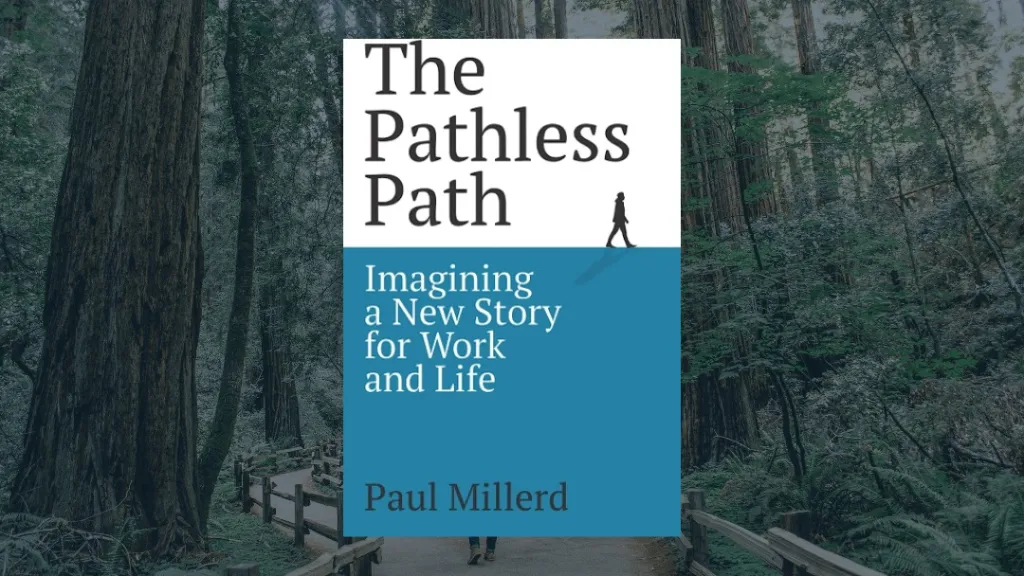
Book Overview
Title: The Pathless Path
Author: Paul Millerd
Category: Personal Development / Career / Life Design
Why I Picked This Book:
I’m rebuilding my life, not escaping it. I’ve got two kids watching how I navigate the tension between providing and being present. The default path—climb the ladder, retire at 65, then live; doesn’t add up anymore. This book kept showing up in conversations with people who’ve
stepped off the treadmill without blowing up their families. I needed to know: is there a way to design work around life, not life around work, without being reckless?
Who Should Read This
This book is for people who feel the pebble in their shoe (something’s off), but they can’t quite name it. It’s for competent professionals questioning whether the next promotion is actually what they want. It’s for fathers and mothers who’ve realised “retire at 65” is a terrible plan if it means missing the present. It’s for introverts tired of performing extroversion at networking events. It’s for strategic thinkers who see the default path clearly and are ready to design something different. If you’ve ever asked “is this how I want to spend my time?” and the answer made you uncomfortable, this book is for you.
Core Ideas & Highlights
1. Awakening—The Pebble in Your Shoe
People want to hear about bold acts of courage, not years of feeling lost. But beyond headlines of dramatic life changes are almost always longer, slower, more interesting journeys. The restlessness is like having a pebble in your shoe—you’re walking and something is off, and it’s mildly uncomfortable. You start asking: Are they happy? What pain are they dealing with? Is this how they want to spend their time? Paul created a daily calendar entry of priorities: health first, then relationships, fun and creativity, and career last. Then came the question: how do you design a life that doesn’t put work first? The answer: you start underachieving at work. In time there are two versions of you: the default path (focused on the next job) and the pathless path (finding footing and paying attention to clues that lead not to another job but to another life).
2. The First Step—Trading Worry for Wonder
Uncertain discomfort + wonder > certain discomfort. When thinking about the future, worry is traded for wonder. People stop thinking about worst-case scenarios and begin to imagine the benefits of following an uncertain path. They get curious about who they might become if they embrace discomfort. Philosopher Agnes Callard explains aspiration as “trying on the values that we hope one day to possess.” People on the pathless path are “characteristically needy people”—their worldview is incomplete and evolving, so they’re dependent on the support of others. That’s why the people is the pathless path need to find the others of the same mindset. Fear falls into five areas: success, money, health, belonging, happiness. Tim Ferriss’s “fear setting” exercise helps re-frame them. The exercise has six steps: write down the change you’re making, list worst outcomes, identify mitigation actions, list steps to get back to where you are today, identify benefits of partial success, and calculate the cost of inaction in three months, twelve months, and a few years.
3. Wisdom of the Pathless Path—Let Go to Accept
According to Joseph Campbell, we must let go of the life we have planned, so as to accept the one that is waiting for us. “Nothing good gets away, as long as you create the space to let it emerge.” Paul noticed four predictable shifts people experienced: (1) People become aware of their own suffering. (2) Curiosity re-emerges. (3) People often desire to continue their “non-work” journey. (4) People write. One major barrier to taking a break is believing we have to wait for retirement. The mini-retirement is not an escape from your life but a reexamination of it—the creation of a blank slate. Tim Ferriss designed mini-retirements by asking three questions: How do your decisions change if retirement isn’t an option? What if you could use a mini-retirement to sample your future plan now? Is it really necessary to commit fully to work to live like a millionaire?
4. Redefining Success—Flipping to the Second Chapter
People are reluctant to flip the page to the second chapter of success because it requires rejecting paths that are not only more accepted but also promise money, respect, and admiration. You become a “bad egg” in the eyes of the default path. You need to find your tribe and find your enough. Success isn’t about external metrics—it’s about designing a life that doesn’t require you to escape from it.
5. The Real Work of Your Life—Start with Questions
One of the best ways to discover your conversation is to start asking questions driven by your curiosity. Paul’s favorite questions: What matters? Why do we work? What is the good life? What holds people back from change? How do we find work that brings us alive? The goal is not to find work, make money, build a business, or achieve any other metric. It’s to actively and consciously search for the work that you want to keep doing. A significant barrier to figuring out what we really want to do is the voice in our head that warns us to stop when we consider things not broadly seen as “normal.” Brené Brown defines shame as “the intensely painful feeling or experience of believing that we are flawed and therefore unworthy of love and belonging.” Most people give too much power to this emotion when making life choices.
6. Remembering What You Forgot—The Power of Curiosity
To thrive on the pathless path, we must ignore the shiny objects and distractions and strip away the stories that are not our own to remember who we are. A more interesting path is possible if you start with what brought you alive in the past. Injecting the energy from these pursuits can lead you in a different direction and help you figure out what to work on while taking the first steps toward creating a life you truly enjoy. Figuring out who you want to serve is an important element. Finding the right people—those who might offer support and encouragement—can have an outsized effect on your confidence and courage to keep going.
7. The Virtuous Meaning Cycle—Work That Makes Life Better
The virtuous cycle is being able to do work that you enjoy that naturally leads to opportunities and people that help make your life better. The biggest challenge to creating your virtuous cycle and one of the most dangerous failure modes of this path is cynicism. Write from your heart, write with care, not hate. When you find work you genuinely enjoy, it creates momentum that attracts more of what you want.
8. Playing the Long Game—Working Backward
One of the goals of the pathless path is to make commitments: to a type of work, ways of living, creative projects, or a “conversation” with the world. How do you begin to figure out what you want to do when there are not many limits? Paul starts with what he doesn’t want to be doing and what failure looks like. He uses Nassim Taleb’s principle of anti-fragile—things that gain strength through disorder. People realise that the challenge is not to find work to pay the bills but instead to have time to keep taking chances and exploring opportunities to find the things worth committing to over the long term.
9. The Positive Side of Freedom—Owning Your Time
Owning your time, then figuring out what to do with freedom once you have it. The better advice is to find out who you are and do it on purpose. Reinvent yourself again and again. Do you think the next 40 years will see more or less change? So invent yourself repeatedly.
10. Embracing Abundance—The Gift Economy
The more you give, the more you get. Charles Eisenstein introduces the idea of a gift economy. Paul embraced three guiding principles: (1) Find ways to give without expectation of anything in return. (2) Be willing to receive gifts in any form and on any timeline. (3) Be open to being wrong about all of this and adjust your approach as necessary. To understand the power of gift, you must first open yourself up to receive. Paul once created a Patreon for his writing, allowing people to make micro-donations to support his work.
11. Coming Alive Over Getting Ahead—Create Your Own Culture
Being able to get to a state where you can spend almost all your time helping, supporting, and inspiring others to do great things with their lives. If the culture doesn’t work, don’t buy it. Create your own. Paul’s assumptions: Many people are capable of more than they believe. Creativity is a real path to optimism, meaning, and connection. We don’t need permission to engage with the world. We are all creative—it takes some people longer to figure that out. Leisure, or active contemplation, is one of the most important things in life. There are many ways to make money, and when an obvious path emerges, there is often a more interesting path not showing itself. Finding the work that matters to us is the real work of our lives.
12. Go Find Out—Ten Things to Do
Paul’s ten-point summary and challenge: (1) Question the default path. (2) Reflect. (3) Figure out what you have to offer. (4) Pause and disconnect. (5) Go make friends. (6) Go make something. (7) Gift generously. (8) Experiment. (9) Commit. (10) Be patient.
My Reflections & Thinking
What resonated with me
- The pebble in the shoe metaphor is perfect. I’ve felt this for years but couldn’t name it. Something’s off. Not terrible, just off. I’m competent, I’m providing, I’m functional—but I’m also restless. My kids are growing up fast, and I’m spending the best hours of my days on work that doesn’t bring me alive. The default path says “this is normal—everyone feels this.” But Paul says: no, that’s a signal. Pay attention to it.
- Health first, then relationships, then fun and creativity, then career. I’ve been living career-first for too long. It’s been the filter for every decision: Does this advance my career? Does this make me more money? But at what cost? My kids don’t care about my career. My wife doesn’t need me to climb higher. They need me present, energised, alive. Paul’s calendar reminder is simple and powerful. I need to flip the priorities.
- “The goal is to actively and consciously search for the work you want to keep doing.” Not the work that pays the most. Not the work that sounds impressive. The work you want to keep doing. That’s the filter. I’ve been chasing external validation—titles, salaries, recognition—when the real question is: do I want to keep doing this? For most of what I’m doing right now, the honest answer is no.
What challenged or changed my perspective
- “You start underachieving at work.” This is uncomfortable. I’m a structured, responsible person. Underachieving feels like lazines. But Paul reframes it: if you want to design a life that doesn’t put work first, you have to stop optimising for work. That means saying no to projects that advance your career but steal from your family. That means protecting your energy for the things that matter most. It’s strategic, not lazy. But it still feels like breaking a rule I’ve internalised for decades.
- The virtuous cycle vs. cynicism. I’ve been sliding into cynicism. “This is just how it is. Everyone struggles. Life is hard.” But Paul says: cynicism is the failure mode. The alternative is the virtuous cycle—work you enjoy that naturally leads to opportunities and people that make your life better. I’ve been telling myself that’s naive. But what if it’s not? What if cynicism is the trap, and curiosity is the path out?
- Embracing abundance and the gift economy. This challenges my scarcity mindset. I’ve been hoarding—my time, my ideas, my expertise—because I’m afraid if I give too much away, there won’t be enough for me. But Paul (and the Islamic principle of Sadaqah I’ve been taught) says the opposite: the more you give, the more you get. Not transactionally. Not immediately. But over time, generosity creates a different kind of wealth. I need to test this, not just believe it.
Final Note
This book didn’t give me a blueprint. It gave me permission to question the default path and design something different. I’m a father of two, a husband, a family-first introvert rebuilding after years of functional-but-unfulfilling work. The default path says: climb the ladder, retire at 65, then live. But my kids will be grown by then. My best years will be gone. Paul’s pathless path says: design a life you don’t need to retire from. Start with what matters (health, relationships, creativity), then fit work around that—not the other way around. It’s not reckless. It’s strategic. I’m not escaping my responsibilities. I’m redefining success so it doesn’t require me to sacrifice the present for a future that may never come. The pebble in my shoe is getting harder to ignore. And maybe that’s a good thing. Because uncertain discomfort plus wonder is better than certain discomfort. I don’t have all the answers yet. But Paul’s framework gives me a place to start: question the default path, reflect, figure out what I have to offer, pause and disconnect, make friends, make something, gift generously, experiment, commit, be patient. I’m doing this for my family. Not despite them. I want my kids to see a father who questioned the default path and built something intentional. Who chose presence over promotion. Who found work worth keeping. The pathless path is about opening yourself up to emergence. It’s about realizing that if I claim to care about something, I need to be willing to act—and be willing to be wrong. I’m ready to be wrong. I’m ready to find out.