
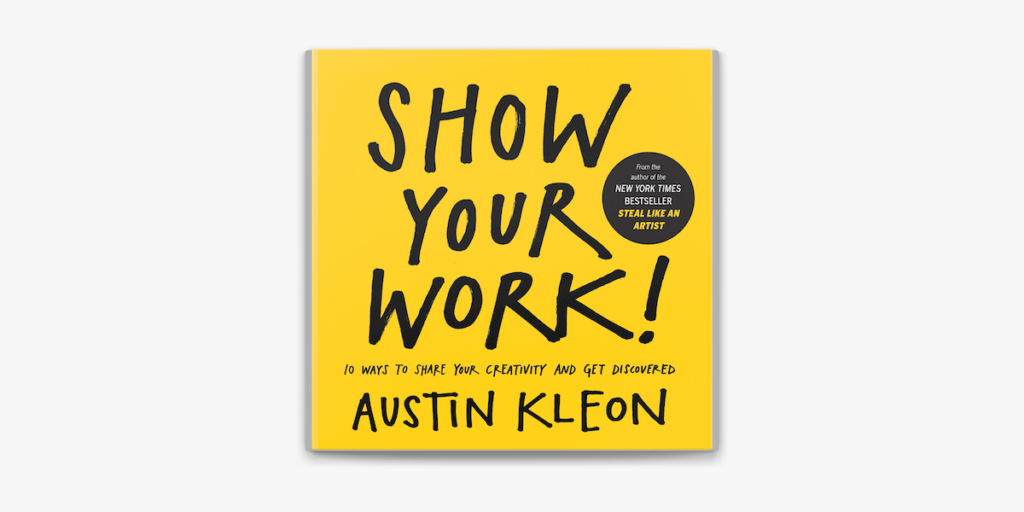
Book Overview
Title: Show Your Work!
Author: Austin Kleon
Category: Creativity / Personal Branding / Career
Why I Picked This Book:
I create things but struggle with self-promotion. Sharing my work feels narcissistic or spammy, so I keep it to myself which means no one sees it, no one benefits, and I stay invisible. This book promised a framework for sharing work without being obnoxious. I needed to understand how to be “findable” in a noisy internet without selling my soul or becoming a shameless self-promoter.
Core Ideas & Highlights
1. You Don’t Have to Be a Genius: Find a Scenius
A scenius is a group of creative individuals supporting each other, looking at each other’s work, copying, stealing ideas, and contributing. Many so-called “lone geniuses” were actually part of a whole scene. Be an amateur. Find your scenius, pay attention to what others are sharing, and then start noting what they’re NOT sharing. That gap is your opportunity.
2. You Can’t Find Your Voice If You Don’t Use It
Talk about the things you love. Your voice will follow. Keep asking questions, keep thinking until you find what you’re looking for. In this age, if your work isn’t online, it doesn’t exist. If you want people to know about what you do and the things you care about, you have to share. Read obituaries, people who experience near-death situations never waste their lives afterward. They become better people.
3. Think Process, Not Product: Become a Documentarian
Take people behind the scenes. Process is messy, but whatever the nature of your work, there’s an art to it. People would be interested in that art if only you presented it the right way. The first step: scoop up the scraps and residue of your process and shape them into interesting bits of media. Start a work journal. Take photographs of your work at different stages. Shoot video. Documenting your process has its own reward: you’ll see your work more clearly and feel like you’re making progress.
4. Share Something Small Every Day: Send Out a Daily Dispatch
If you’re in the early stages, share your influences and what’s inspiring you. If you’re executing a project, write about your methods or share works in progress. If you’ve completed a project, show the final product, share scraps from the cutting room floor, or write about what you learned. The form doesn’t matter; blog post, email, tweet, YouTube video. Work while the world is sleeping, and share while the world is at work. Don’t show your lunch or latte; show your work.
5. The “So What?” Test
Be open, share imperfect and unfinished work you want feedback on, but don’t share absolutely everything. Don’t overthink it; go with your gut. If you’re unsure about whether to share something, let it sit for 24 hours. Take it out with fresh eyes and ask: Is this helpful? Is it entertaining? Is it something I’m comfortable with others seeing? There’s nothing wrong with saving it for later.
6. Turn Your Flow into Stock
Flow is the feed, daily posts and updates. Stock is the durable stuff, the evergreen content. The magic formula is to maintain your flow while working on your stock in the background. Be consistent with your posting so that your flow will turn into stock. A blog is the ideal machine for turning flow into stock. Go register a domain name: www.[yourname].com. Don’t think of your website as a self-promotion machine; think of it as a self-invention machine.
7. Open Up Your Cabinet of Curiosities: Don’t Be a Hoarder
Where do you get your inspiration? What do you fill your head with? What do you read, listen to, watch? Who have you done work you admire? Who do you steal ideas from? Who are your heroes? When you find things you genuinely enjoy, don’t let anyone make you feel bad about it. Being open and honest about what you like is the best way to connect with people who like those things, too. No guilty pleasures. Credit is always due, always provide links back to creators.
8. Tell Good Stories: Work Doesn’t Speak for Itself
Words matter. Our work doesn’t speak for itself. The stories about the work you do have a huge effect on how people feel and what they understand about your work, and how they feel affects how they value it. If you want to be more effective when sharing yourself and your work, you need to become a better storyteller. Structure is everything. A good pitch has three acts: (1) Past: where you’ve been, what you want, how you came to want it. (2) Present: where you are now, how you’ve worked hard and used up resources. (3) Future: where you’re going, and how the person you’re pitching can help you get there.
9. Teach What You Know: Share Your Trade Secrets
When you share your knowledge and work with others, you receive an education in return. Teaching is a free education that goes on for a lifetime. The more you give away, the more you learn. Don’t hoard your knowledge, it compounds when shared.
10. Don’t Turn Into Human Spam: Shut Up and Listen
If you want to be a writer, you have to be a reader first. If you want fans, you have to be a fan first. If you want to be accepted by a community, you have to first be a good citizen of that community. If you want to get, you have to give. If you want to be noticed, you have to notice. Be thoughtful, be considerate, be an open node. Don’t follow people just because you think it’ll get you somewhere. If you want followers, be someone worth following.
11. You Want Hearts, Not Eyeballs
Stop worrying about how many people follow you online and start worrying about the quality of people who follow you. Don’t waste time following people just because you think it’ll benefit you. Don’t talk to people you don’t want to talk to, and don’t talk about stuff you don’t want to talk about. The vampire test: If, after hanging out with someone you feel worn out and depleted, that person is a vampire (toxic). If you still feel full of energy, they’re not a vampire.
12. Identify Your Fellow “Knuckleballers”
As you put yourself and your work out there, you’ll run into your fellow knuckleballers; your real peers who share your obsessions, your mission, and mutual respect. There will only be a handful, but they’re so important. Do what you can to nurture these relationships. Sing their praises, invite them to collaborate, show them work before anyone else, share your secrets, keep them close. Attention is vitality. It connects you with others.
13. Learn to Take a Punch, Let Them Take Their Best Shot
When you put your work out into the world, you have to be ready for the good, the bad, and the ugly. Here’s how to take punches: (1) Relax and breathe. Fear is often just imagination taking a wrong turn. Bad criticism isn’t the end of the world. (2) Strengthen your neck. Put out a lot of work, let people take their best shot, then make more. (3) Roll with the punches. Every piece of criticism is an opportunity for new work. (4) Protect your vulnerable areas. If work is too sensitive, keep it hidden but remember that compulsive avoidance of embarrassment is a form of suicide. (5) Keep your balance. Your work is something you do, not who you are.
14. Don’t Feed the Trolls, Evaluate Feedback Sources
The first step in evaluating feedback is sizing up who it came from. You want feedback from people who care about you and what you do. Be extra wary of feedback from anybody outside that circle. The trick is not caring what EVERYBODY thinks of you and just caring about what the RIGHT people think of you.
15. Sell Out, Even the Renaissance Had to Be Funded
The word “sellout” is spit out by the bitterest, smallest part of ourselves. Don’t be one of those horrible fans who stops listening to your favorite band just because they had a hit single. Don’t write off your friends because they’ve had success. Don’t be jealous when people you like do well; celebrate their victory as if it’s your own. When your audience starts gathering, you might want to turn them into patrons. Put a virtual tip jar or DONATE button on your website. Keep a mailing list; collect email addresses from people who want to stay in touch. Email is old, boring, utilitarian, but it works. Build your list and treat it with respect.
16. Make More Work for Yourself: Pay It Forward
A life of creativity is all about change, moving forward, taking chances, exploring new frontiers. Be ambitious. Keep yourself busy. Think bigger. Expand your audience. Try new things. Take opportunities (positive ones). Be generous to others, but be selfish/disciplined with your work. Every career is full of ups and downs. You can’t plan on anything; you can only go about your work. Work is never finished, only abandoned.
17. Chain-Smoke: Avoid Stalling Out
Whether you’ve won big or lost big, you still have to face the question: “What’s next?” Chain-smoking means you avoid stalling out by never losing momentum. Instead of taking a break between projects, use the end of one project to light up the next one. Just do the work in front of you, and when it’s finished, ask what you missed, what you could have done better, and jump into the next project. We work because it’s a chain reaction, each subject leads to the next.
18. Go Away So You Can Come Back, Take Sabbaticals
Take breaks from connected life: commute, exercise, spend time in nature. Turn off your brain periodically. When you feel like you’ve learned whatever there is to learn from what you’re doing, it’s time to change course and find something new to learn so you can move forward. Document your progress and share as you go so others can learn along with you. Show your work, and when the right people show up, pay close attention, they’ll have a lot to show you.
My Reflections & Thinking
What resonated with me
- “In this age, if your work isn’t online, it doesn’t exist.” This is harsh but true. I’ve been creating in isolation, assuming quality alone will be discovered. But without sharing, I’m invisible. No one can care about work they don’t know exists.
- The “self-invention machine” reframe for websites. I’ve always thought of personal websites as self-promotion (gross). But Kleon says: it’s a machine for inventing yourself, for figuring out who you are and what you care about in public. That makes sharing feel less narcissistic and more exploratory.
- Chain-smoking projects to avoid stalling out. I take long breaks between projects to “recharge,” but I lose momentum. Kleon’s advice: use the end of one project to ignite the next. Don’t wait for feedback or perfect conditions. Just keep moving. That solves my chronic stop-start problem.
What challenged or changed my perspective
- “Think process, not product.” I’ve been obsessed with only sharing polished, finished work. Kleon says: show the messy process, the scraps, the behind-the-scenes. People are interested in the art of what you do if you present it right. But I’m uncomfortable with imperfection being visible. That’s a tension I need to work through.
- The vampire test is brutal but necessary. I have relationships that drain me, but I keep them because I feel obligated or because I’m scared of conflict. Kleon’s test is simple: after hanging out, do you feel energized or depleted? If depleted, they’re a vampire. Cut them loose. That’s permission I didn’t know I needed.
- “You want hearts, not eyeballs.” I’ve been obsessed with follower counts and vanity metrics. Kleon shifts focus: quality of people who follow you matters more than quantity. A small, engaged audience of the right people beats a massive audience of the wrong people. That’s a relief and a filter.
Who Should Read This
This book is for creators who struggle with self-promotion; artists, writers, designers, entrepreneurs, anyone making things in isolation who doesn’t know how to share without feeling gross. It’s for people who think “marketing” is for sellouts. It’s for those paralyzed by perfectionism, waiting for work to be “ready” before sharing. It’s for introverts who want to build an audience without being loud or obnoxious. And it’s for anyone who’s been told “just network” but doesn’t know what that actually means in the internet age. If you create and want to be found, this is your manual.
Final Note
This book didn’t teach me how to “go viral” or “hack the algorithm.” It taught me that sharing work is an act of generosity, not narcissism. That documenting the process is as valuable as the product. That you can build a career by being genuinely helpful, curious, and open. Kleon’s framework, share something small every day, turn flow into stock, teach what you know, find your scenius, take punches, chain-smoke projects, removes the mystery from “how do I get my work out there?” The answer isn’t hustle or spam. It’s showing up consistently, being yourself, and trusting that the right people will find you if you’re findable. I’ve been hiding because I was scared of judgment, scared of looking stupid, scared of being seen. But Kleon’s message is clear: work that stays hidden doesn’t exist. And I don’t want to spend my life creating in a vacuum. So I’m going to start showing my work. Imperfect, unfinished, messy process and all. Because the right people—my scenius, my knuckleballers; won’t judge me for the mess. They’ll see the art in it. And that’s who I’m creating for anyway.